There is a moment we all know. Perhaps just after waking, or late at night before the mirror, when the world shrinks to a single, irrefutable feeling: here I am. There is this body you call home, with a heartbeat as its familiar rhythm. A single entity, one person, a distinct “I” that navigates the day, makes decisions, loves, and doubts. This perception is so fundamental that we scarcely ever question it. It is the foundation of our experience.
But what if this foundation is not as solid as we believe? What if, upon closer inspection, the clear boundary between “me” and “the world” begins to blur? The journey toward this question begins not in philosophy, but in a much more immediate place: within your own body.
Who Actually Lives Here?
Your body is a remarkable interplay of countless parts. On the one hand, there are your own human cells—an estimated 30 trillion of them. An unimaginable number, yet it is only part of the whole. For you share your body with at least as many microbial cohabitants—bacteria, viruses, fungi, and archaea. Together, they form your microbiome. When one considers the genetic diversity, the picture becomes even more drastic: for every single human gene in your body, there are around 100 genes from these tiny helpers.
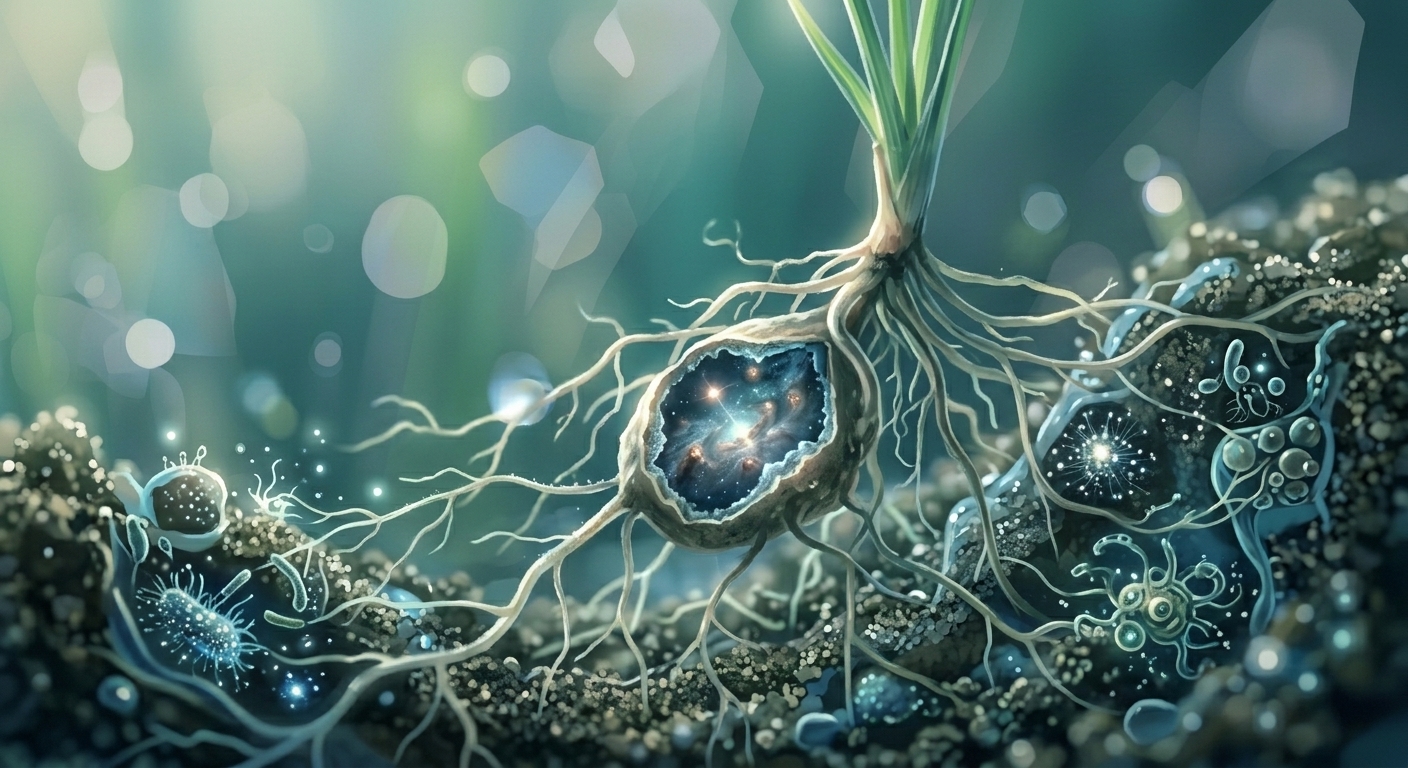
This realization is more than an astonishing statistic. It is an invitation to rethink the concept of a completely independent self. The body you refer to as “yours” is, in truth, an ecosystem. A bustling landscape whose inhabitants work tirelessly to maintain the very equilibrium that you experience as your life and your health. They are not invaders or stowaways. They are a part of you, as inseparable as your lungs or your heart.
The Whisper Between Gut and Brain
Why is this so? Because over millions of years of evolution, a profound partnership has developed. These microorganisms are not enemies to be fought, but essential allies. They help digest food that our own enzymes cannot break down, they produce vital vitamins, train our immune system, and defend their territory—our body—against harmful germs.
Perhaps the most fascinating discovery of recent years is the so-called gut-brain axis, a complex communication network. Researchers are increasingly understanding how intimately the gut microbiome engages in a constant dialogue with our brain. Certain gut bacteria produce neurotransmitters like serotonin or dopamine—the very messengers that significantly shape our mood, our anxieties, and our sense of well-being. The proverbial “gut feeling,” then, is not a mere figment of the imagination, but the result of a real biochemical conversation. A feeling, an intuition, even a thought is perhaps never solely your own creation, but rather the result of a polyphonic orchestra in which you may set the direction, but you are not the only musician.
This form of symbiosis—the close, mutually beneficial coexistence of different species—is ubiquitous in nature. A tree in the forest is rarely just a tree; it is part of an underground fungal network that exchanges nutrients and information among the forest's inhabitants. A coral is not a single animal, but a living community with algae that gift it energy through photosynthesis. It seems as though life consistently prefers the principle of cooperation to that of isolation. The idea of a radically separate individual is perhaps more a human narrative than a biological reality.
From I to We: A Quiet Shift in Perspective
This realization need not overturn your daily life. And yet, it can fundamentally change the way you experience it. It need not cause discomfort, but can instead create a deep sense of connection—not only with the world out there, but also with the world within you. You are never truly alone.
Perhaps this perspective invites a small, quiet experiment. In a moment when you feel overwhelmed, lonely, or exhausted, try to consciously remember this inner community. The trillions of helpers working tirelessly for your equilibrium.
It is not about relinquishing responsibility. It is about replacing the feeling of a solitary burden with an awareness of the community you have always been. This thought may not lift the burden immediately, but it can soothe the feeling of isolation. It is a small gesture of acknowledgment for the trillions of lives that make your own life possible. A silent greeting to the cosmos within you.
The next time you look in the mirror, you might see more than just a face. You see the expression of an entire, living, and wonderfully complex world looking back at you.
Further Reading
- Yong, Ed. I Contain Multitudes: The Microbes Within Us and a Grander View of Life. Ecco, 2016. An accessible and brilliantly written book that opens up the world of the microbiome to a wide audience.
- Mayer, Emeran A. The Mind-Gut Connection: How the Hidden Conversation Within Our Bodies Impacts Our Mood, Our Choices, and Our Overall Health. Harper Wave, 2016. A detailed exploration of the gut-brain axis from one of the leading researchers in the field.
- Sender, R., Fuchs, S., & Milo, R. (2016). Revised Estimates for the Number of Human and Bacteria Cells in the Body. In: PLoS Biology. A scientific publication that refines the often-cited figures on the ratio of human to microbial cells. Available online.
You might also be interested in
The Anatomy of a Sigh: How Breathing and the Nervous System Work Together
Now that you have discovered the hidden communication between gut and brain, learn more here about another unconscious connection in your body: the one between your breath and your nervous system.
Memory, a Storyteller
Your microbiome shapes your physical “I.” But what shapes your personal story? Discover how your memory does not just store facts, but actively crafts the narrative of your life.
The Nocturnal Atelier: What Our Brain Does for Us While We Sleep
The community within you works around the clock. In this article, learn about the amazing tasks your brain takes on while you sleep, and how it prepares your waking “I.”