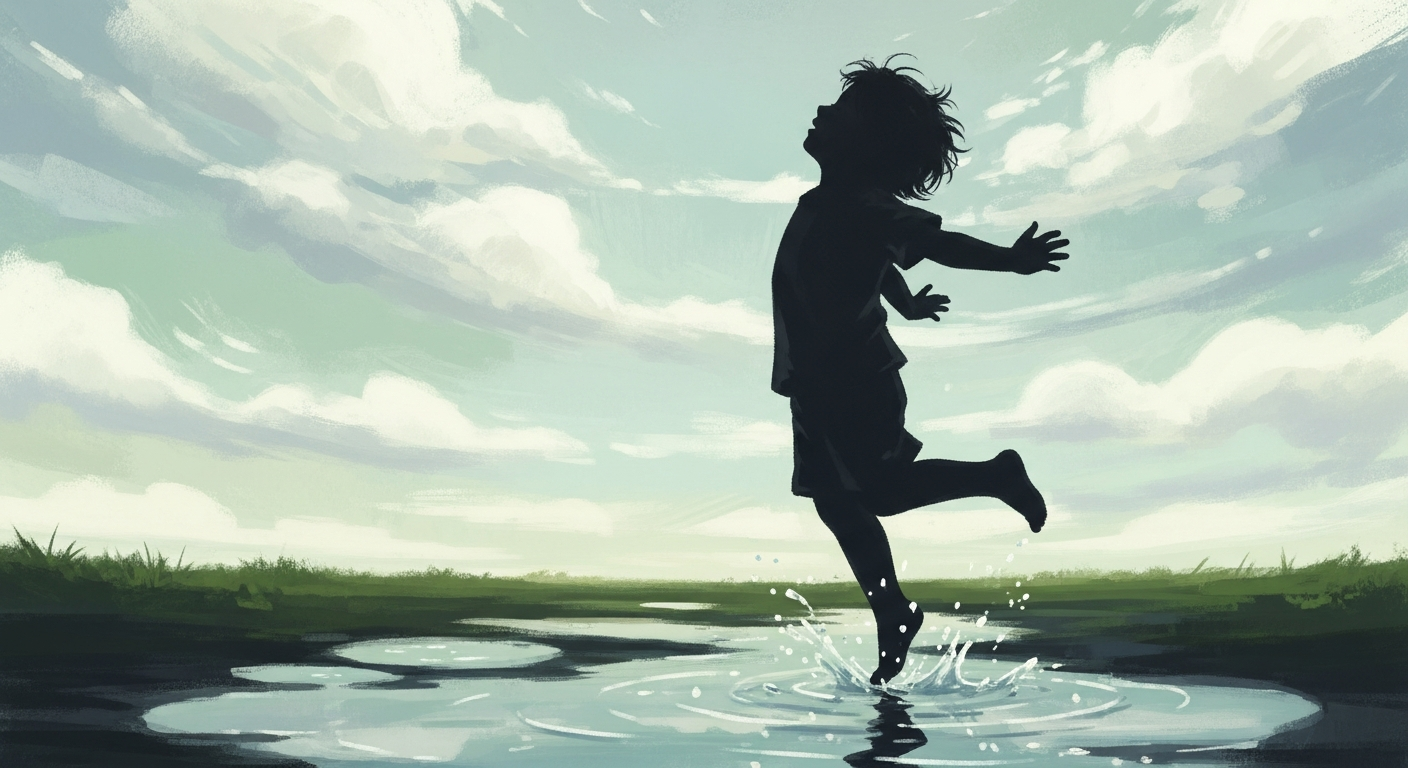
When was the last time you looked at something as if you were seeing it for the very first time? Without immediately naming it, without knowing what purpose it serves? A child kneels on the parquet floor, head almost touching the ground. Its entire attention is devoted to a ball of yarn lying beneath the armchair. For us, it is merely that: a ball of yarn, the remnant of a knitting attempt, something that will need to be tidied away later. For the child, it is an unexplored being. It prods it, observes how it yields, pulls at a loose thread. It doesn't ask what it is, but what it can do. Its curiosity is an open, physical state of exploration.
Perhaps you know a version of this moment. You see a child discovering the reflection of clouds in a puddle, letting a ladybug crawl up the back of their hand, or asking for the tenth time why the sky is blue. And perhaps you feel a faint pang – a remembrance of a time when the world was not made of facts and tasks, but of countless, fascinating possibilities. Sometimes, however, it is merely a flicker of impatience, the impulse to end this seemingly aimless fascination and move on to the order of the day.
As adults, we have often traded questioning for knowing. We have learned to quickly categorize things, to name them, and to tick them off our list. The cloud is a cloud, the puddle a hazard for dry shoes, the beetle an insect. This knowledge is vital for survival. It enables us to act effectively in a complex world. We navigate through daily life by drawing upon our inner maps, upon proven routes and familiar designations.
But what if these maps become our sole reality? What if we forget that they are merely a simplification of the actual terrain? Then, while we move safely, we no longer discover anything new. The world becomes predictable, sometimes even a little grey. Our answers become routine, our solutions to problems often merely variations of what we have always done.
The Familiar World
The unlearning of curiosity is not a conscious act, but a gradual process. It begins where the question „What if?“ is replaced by the assertion „That's just how it is“. There, where we cease to look at things ourselves, and instead content ourselves with their labels.
Yet, curiosity is more than just childish play. It is an attitude, a way of being in the world. A curious mind doesn't necessarily seek a final answer to conclude a subject. It wants to open up a space. It doesn't ask to fill a gap in knowledge, but to allow for wonder at the very existence of the gap itself.
In Zen Buddhism, there is a term for this: Shoshin, the „beginner's mind“. It describes a state of openness, free from preconceptions and preconceived notions – even when encountering a subject one believes to know well. It is the attitude of someone willing to see everything as if it were the first time. This mind is not naive, but wise. It knows that every answer is always merely provisional, and that the most interesting discoveries often lurk at the edges of the known.
The Permission to Wonder
To rediscover this attitude requires no grand journey or radical rethinking. It requires no to-do list and no workshop. Perhaps it only requires the permission not to have to know everything for a moment.
It can begin with small things. Taking a street you've never walked down on your way to work. Asking a friend a question whose answer you think you know, and then truly listening. Investigating a sound in your apartment instead of merely cataloging it as „the heating“. It is about pausing for a moment before the inner drawer springs open and presents its label.
To reopen oneself to curiosity does not mean shedding the responsibilities of adult life. It means enriching them. For when we are stuck – in a project, in a conversation, in a thought pattern – the solution rarely lies in the familiar answers. It often lies in a new question. A question that pulls us out of routine and reminds us that the world, and indeed ourselves, are always a little more unfathomable than our inner maps would have us believe.
What if the truly important discoveries do not await us at the destination of our quest, but rather in the willingness to set out at all – without knowing where?