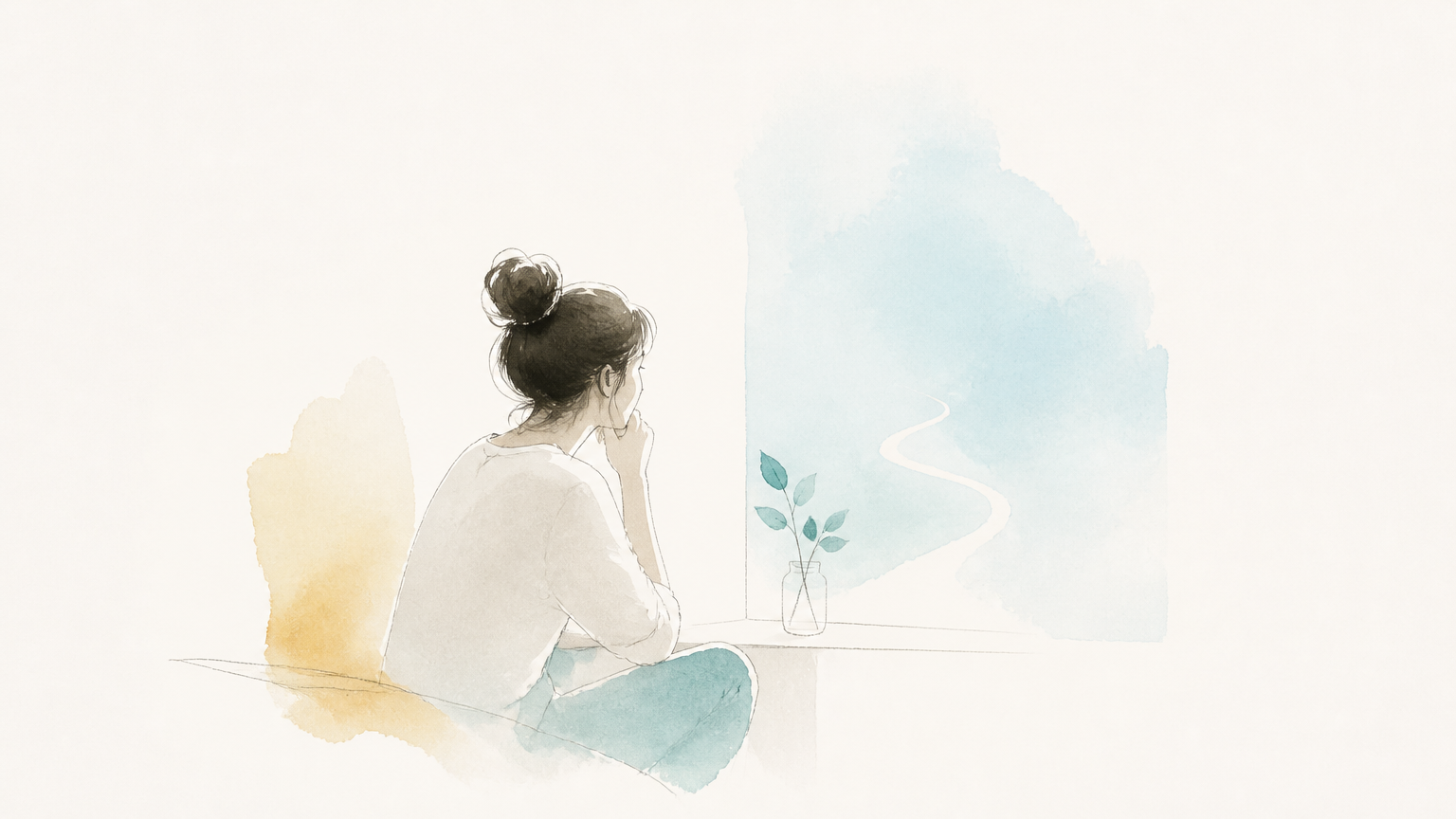
Adizah Eghan goes to a café because the internet is faster there. She is spending a year in India and wants to download Beyoncé’s visual album, which was new at the time. Back home, she sits on the bed with her laptop and presses play.
Colors, dance, music. And suddenly, the feeling of rediscovering something she hadn’t even realized she was missing. That is how the radio producer describes the moment later on the podcast *The Science of Happiness*. She feels inspired and excited by the idea of who she could be. [1]
The remarkable thing about it: The desire wasn't there from the start—neatly formulated and ready for a to-do list. First came something that resonated with her.
Perhaps this is a starting point when the question "What actually does me good?" seems too big right now. Not trying to examine one’s entire life at once. Just sticking with a single scene, a song, or an encounter for the moment: What exactly about it would I like to have in my life, too?
The dream job was there. Another wish, too.
At 25, Eghan lands her dream job as a producer for the radio show and podcast *Snap Judgment*. Yet, when she later tries a writing exercise about her hoped-for future, she thinks first of relationships, not her career.
She realizes how little time she has made for her friends. Her wish becomes very vivid: people she can rely on. People with whom she will grow old. People whose children might one day meet her own children.
A memory is part of this. Her parents are from Ghana and built up their own network of family-like ties with other Ghanaians in the area. As a child, this community was simply a given for Eghan. Now she realizes that it was driven by people who reached out to one another and maintained contact. [1]
The practice doesn't just make her confident. It also makes her more restless: Is she herself doing enough for the community she desires?
So, a more distinct wish doesn't immediately feel comfortable within her story. It also reveals a gap to her. Yet, this needn't turn into a new reproach—the idea that now, on top of everything else, she ought to be cultivating friendships in an exemplary way.
The writing exercise is called "Best Possible Self." The Berkeley guidelines call for writing for 15 minutes a day for two weeks about the best possible future for oneself—including concrete details regarding relationships, work, hobbies, or health. Grammar can be set aside during this process. Obstacles are meant to recede into the background while writing; naturally, they do not disappear from real life as a result. [2]
If such a vision of the future sparks your curiosity, you can give it a try. If it turns primarily into a sense of "this is how I should have been long ago," you are free to set it aside. A single good moment can also serve as a starting point. You do not need an idealized image of yourself.
Do I want this – or should I want it?
Some wishes sound suspiciously like someone else’s voice: achieving more, being more sociable, finally having an impressive hobby. Other things matter to us, even though they neither glitter nor are always fun.
A distinction from self-determination theory is helpful here: We can act out of a desire for reward, fear of consequences, or internalized pressure. But we can also do something because it interests us, brings us joy, or aligns with our own values. A personal wish, therefore, does not necessarily have to aim solely at pleasure. A difficult conversation can be important to you, even though you aren't looking forward to it. [3]
The theory also describes three basic psychological needs:
- Autonomy: Experience the options available and stand by your own actions.
- Expertise: Experiencing that you are capable of something and that your actions make a difference.
- Connectedness: Feeling close to other people and a sense of belonging.
These are helpful perspectives, not three additional tasks. And they do not concern only your inner life: people around you can support these needs or stand in their way. A lack of freedom of choice cannot simply be reflected away. [3]
Six questions for self-reflection – not a test
If you like, pick one question that resonates with you. A few keywords will suffice. The other questions can remain unanswered.
1. What story, piece of music, or encounter has recently resonated with me?
What was it exactly: the quiet, the high spirits, the sense of togetherness, the freedom to try something out?
2. What would a good, ordinary day look like for me?
Not a dream vacation with perfect lighting. More like a Tuesday: What would you do, where would you be, and with whom?
3. What about this wish interests me or is personally important to me?
And where am I more likely to hear "I *should* want that"? You don't have to turn this into two neatly separated lists.
4. In what situation can I make my own decisions and stand behind what I do?
Perhaps it involves a small choice in everyday life, perhaps a more significant boundary.
5. During which activity do I notice that I am capable of doing something or am learning something new?
It doesn't have to be an award-worthy achievement. Even a repaired zipper counts.
6. With whom do I feel a sense of belonging and that my feelings are taken seriously?
What kind of togetherness would you like more of?
These questions are prompts, not a test with a hidden correct answer. You can also simply state: "I don't know anything about that right now."
Getting to know a wish on a small scale
An answer doesn't have to turn into a life plan right away. Instead, you could look for a manageable opportunity to try something out.
Suppose a story particularly moves you because of the natural way friends spend time together. One possible step would be to invite someone for a walk. You don’t have to organize a circle of friends for the next forty years right away; just see how that meeting feels first.
Or perhaps you are drawn to a scene where someone is completely absorbed in a hands-on activity. You might want to try your hand at something, or perhaps the appeal lies in the undisturbed time. You can leave that open while you gain your first experiences.
Afterwards, you could make a note of: What was pleasant? What was important to me, even though it was strenuous? What was less suitable than I had expected?
"Different than expected" is also a valid answer. You don’t have to stick to your initial assumption, nor do you have to turn every beautiful moment into a new hobby.
For today, a short sentence might suffice: I'd like a little more of that.
---
Sources and Contextualization
[1] The Science of Happiness: “How to Find Your Best Possible Self”, Greater Good Science Center, March 19, 2018. This forms the basis for Adizah Eghan’s experience with the album, her career path, and her desire for community. These are personal experiences, not evidence of general effects. In the conversation, psychologist Serena Chen also explains how idealized visions of the future can create pressure.
[2] "Best Possible Self", Greater Good in Action. Source for the procedure and duration of the writing exercise. The study by Sheldon and Lyubomirsky (2006) summarized there reports increases in positive feelings among predominantly white, female students—but provides no evidence that the exercise reliably yields the “right” wishes or decisions.
[3] Self-Determination Theory of Motivation, University of Rochester Medical Center. Patient information on motivational qualities, autonomy, competence, and relatedness, as well as the supportive or hindering role of the social environment.
The six reflection questions and the idea of a small everyday experiment are editorial suggestions derived from these stories and concepts. They do not constitute a scientifically validated instrument.
Created with AI.