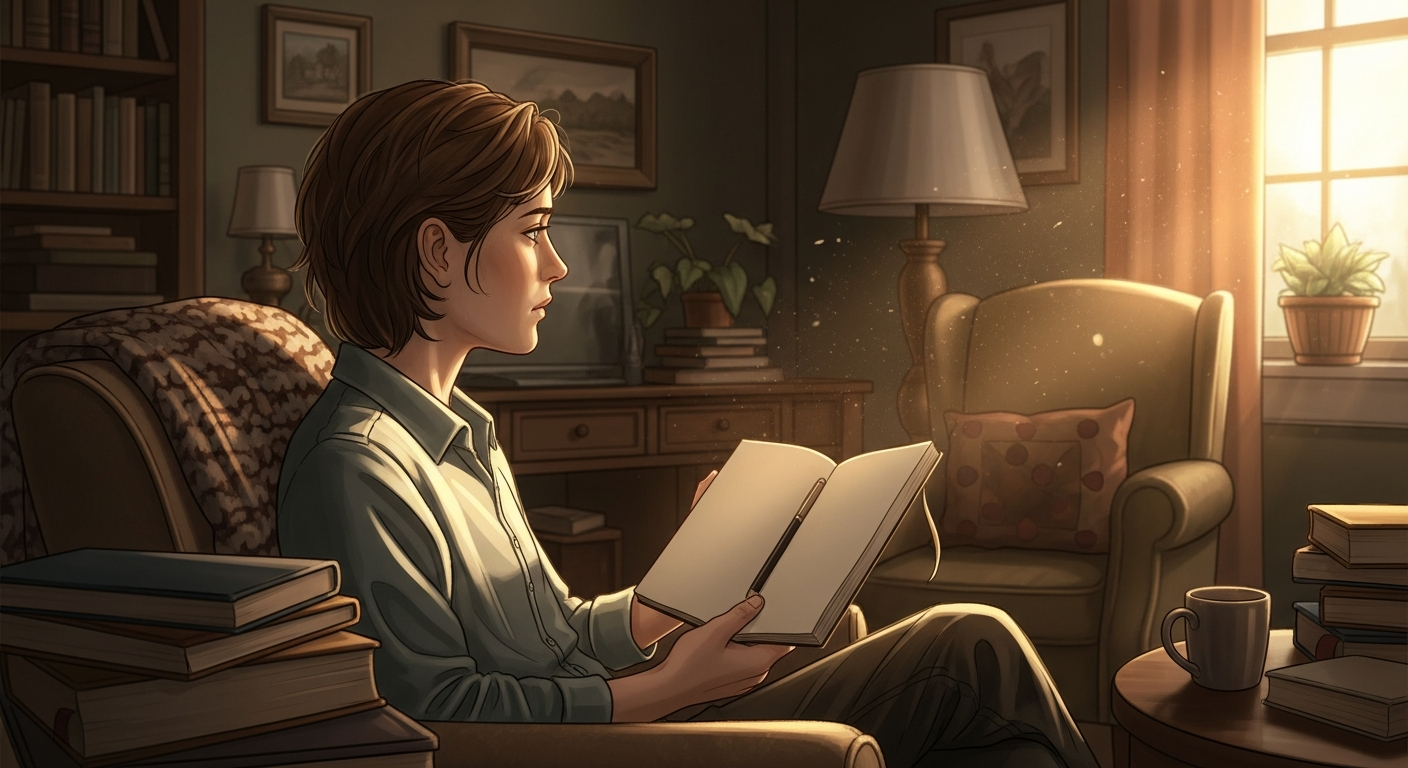
A few weeks ago, I sat in a café, observing an older man at the neighboring table. He held his cup with both hands, hands etched by a life of labor – fine scars, thickened joints, a map of lines. I wondered what all those hands had done. Perhaps they had carved wood, played instruments, written letters, or repaired machines. And then another thought arose: What had they *not* done? Which book had they never written, though the story for it slumbered within them? Which painting never painted?
This thought captivated me. It opened the door to an invisible library, one that we all carry within us and that surrounds us everywhere. A library whose shelves are not filled with printed books, but with possibilities. With the lives we could have led, the decisions we could have made differently, and the talents we never fully unfolded.
Shelves Full of Possibilities
This invisible library is not a place of sorrow or regret, even if that's often the first thing that comes to mind. Rather, it is a quiet archive of our human potential. There stands the novel your grandmother always wanted to write, before the children came along. There you'll find the album with the songs your school friend would have composed, had he dared to give up the secure job. And perhaps there's also a book with your name on its spine – about the language you never learned, or the journey you always postponed.
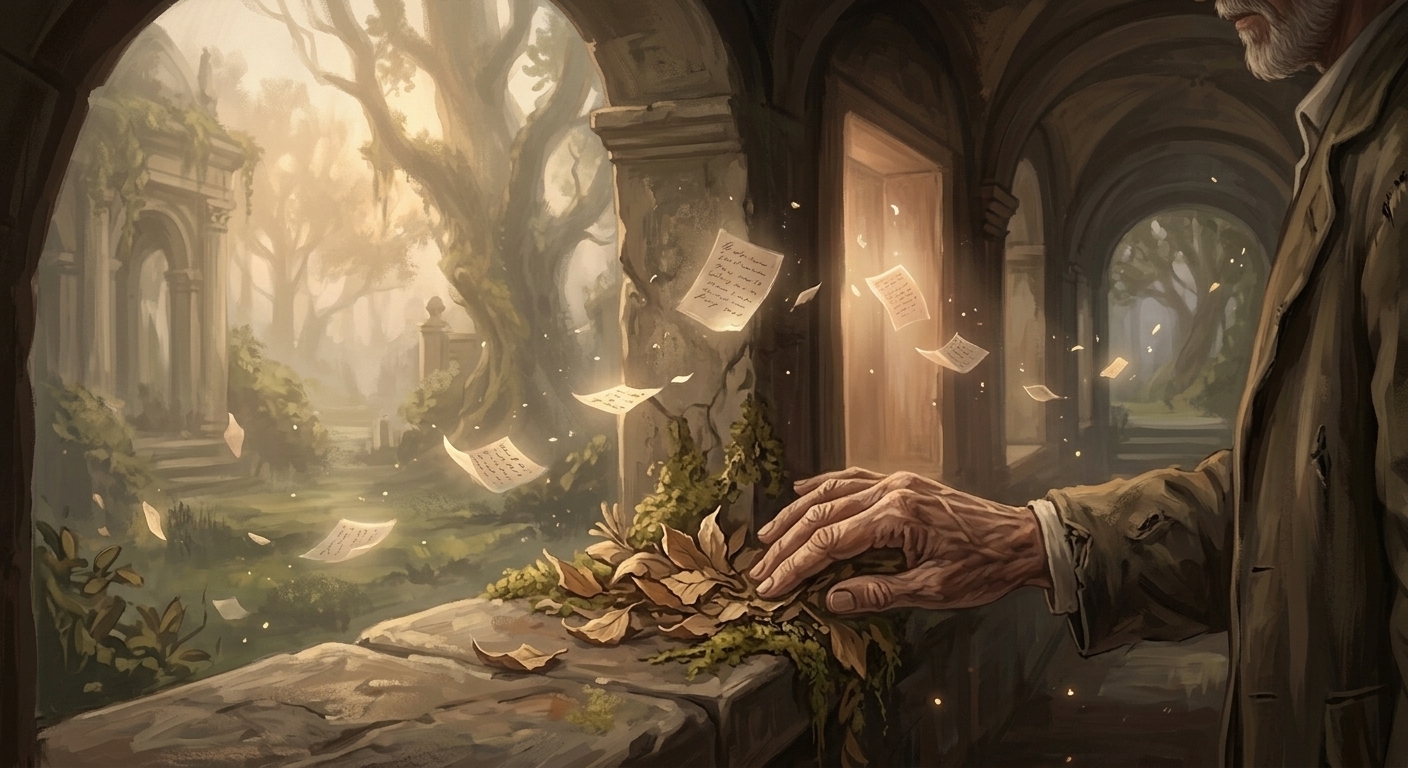
We tend to view these unwritten books as failures or as a deficit. Our culture is fixated on the visible, the completed, the realized. A resume lists what we have done, not what we could have done. Success magazines tell the stories of those who have transformed their “invisible books” into bestsellers. This creates a subtle pressure: every unused potential is a missed opportunity, a debt to be paid. But what if we change our perspective?
The Grammar of the Subjunctive
This thought experiment has a name in psychology: counterfactual thinking. It describes the human ability to ask: “What if …?” For a long time, it was believed that this type of thinking primarily led to regret and remorse. Today, however, we know that it serves an important purpose. When we imagine what could have been, we understand the present better. It helps us learn from decisions and gain a sense of life's multifaceted nature.
The “what if” question is thus not a weakness, but a kind of human superpower. It allows us to mentally transcend what actually happened. The unwritten books in our inner library are therefore not a sign that we have failed. On the contrary: they bear witness to the richness of our imagination. They remind us how many paths a life can take. These unlived possibilities are not lost chapters – they are a quiet part of what makes us who we are today.
From Regret to Appreciation
The common advice now would be to encourage you to finally write all those books. “Stop dreaming, start doing!” Yet this impulse overlooks the beauty that lies in the unfulfilled. A life has only a finite number of days. We cannot walk every path, bring every talent to mastery, or tell every story to its end. The decision for one path is always also a decision against countless others.
Instead of seeing the invisible library as a monument to omissions, we can visit it as a place of dignity and empathy. When we acknowledge the unwritten books within ourselves, without condemning ourselves for them, we develop a deeper self-acceptance. We understand that our worth lies not only in what we produce, but also in the depth of our potential and the complexity of our inner world.
This attitude becomes even more powerful when we apply it to others. Behind every person we encounter – the stressed cashier, the noisy neighbor, the silent colleague – lies their own invisible library. Instead of judging people only by what they do and who they seemingly are, we can ask ourselves: What stories slumber within them? Which unsung song, which unpainted picture?
A Small Exercise in Seeing
This is not an invitation to analyze the lives of others, but an invitation to a quiet, inner gesture of curiosity and respect.
Try it the next time you're sitting on a train, waiting in a queue, or listening to a conversation. Instead of quickly categorizing the person opposite you or the people around you, pause for a moment. Imagine you could glance into their invisible library. You don't have to say or do anything. It's simply about opening your perception to the hidden richness that resides in every human being.
This small shift in perspective can change everything. It transforms fleeting encounters into moments of potential connection. It makes us more patient, more forgiving, and infinitely more curious about the world. We stop reading only the visible titles and begin to listen to the quiet music between the lines.
It is perhaps the quietest and, at the same time, the most human way to read a book.
Further Reading
- Neal Roese, If Only: How to Turn Regret Into Opportunity, Broadway Books, 2005. An accessible exploration of counterfactual thinking and its role in our emotional lives.
- Jorge Luis Borges, “The Library of Babel” in Fictions, Fischer Taschenbuch, 2005. A literary master narrative about the concept of an infinite library that contains everything that could ever be written.
- David Eagleman, Sum: Forty Tales from the Afterlives, Canongate Books, 2009. A collection of short, philosophical stories that play with different versions of life and potential.
You might also be interested in
What if happiness isn't a destination at all?
This article questions the pressure to realize every potential. Discover here why the constant pursuit of happiness often does more harm than good, and how a fulfilling life beyond the pressure of optimization can look.
The Art of Not Knowing
At the end of the article, you are invited to curiosity and a new perception of others. This contribution shows you how you can practically rediscover and cultivate this curious attitude, the “beginner's mind,” in everyday life.
The World in a Hand Movement
The article begins with the observation of hands and the stories they could tell. Discover here how our gestures and hand movements actually carry a rich, invisible knowledge about culture and our lives.