
A completely dark room. No crack of a door, no glow of a display, just impenetrable blackness. Your eyes are open, they scan the darkness, but they find no purchase.
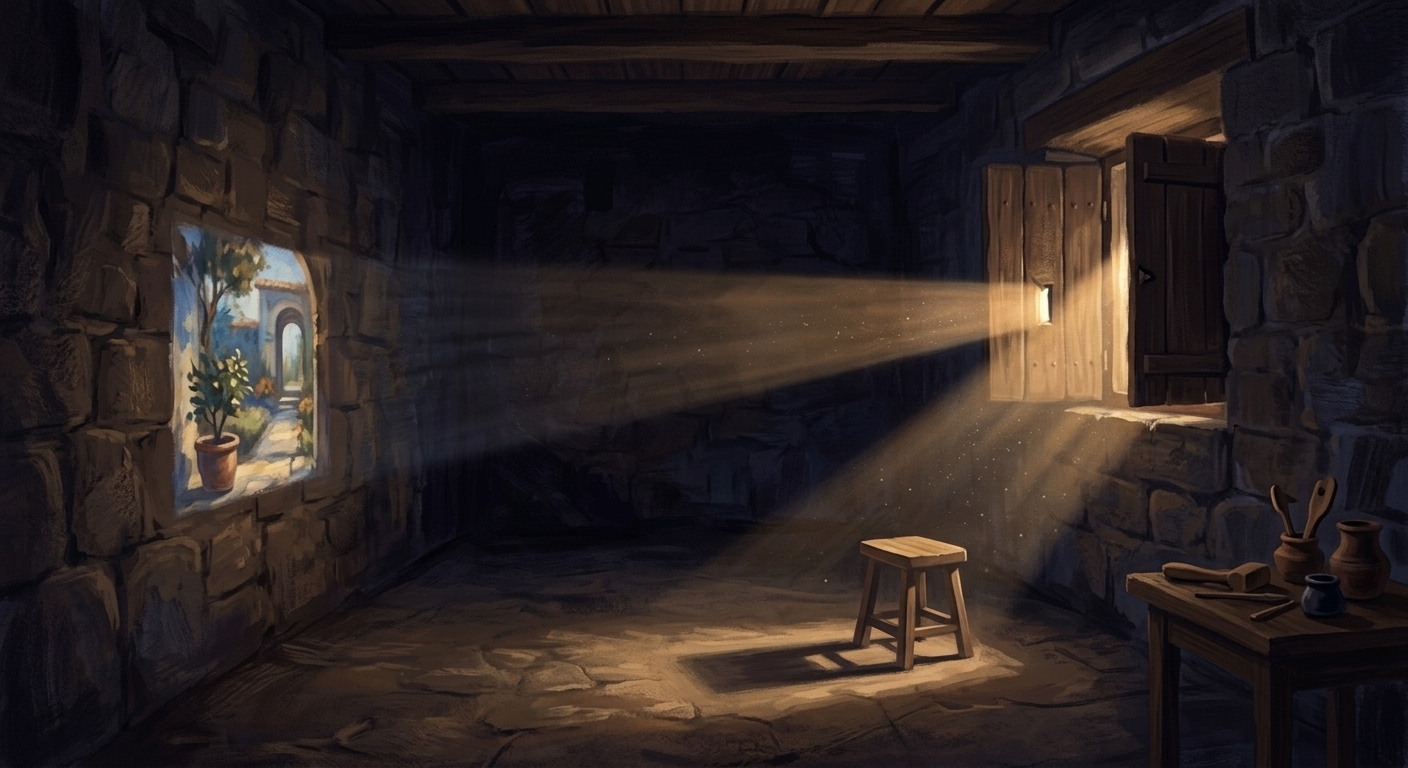
Then a tiny slit opens in a shutter. A single, sharply defined sunbeam falls in, painting a luminous spot on the opposite wall. In this beam of light, dust particles dance, particles you had just inhaled without noticing them. The world is no longer merely present; it becomes visible.
This observation feels self-evident today. But within it lies the core of an idea that has quietly, yet radically, transformed our understanding of the world and our place within it. The story behind it begins with an assumption that seems alien to us today, yet for over a thousand years, it shaped the thinking of the greatest minds.
The World as a Projection
For ancient thinkers like Plato and Euclid, the matter was clear: we can see because our eyes possess a kind of inner fire. Invisible “visual rays,” so the theory went, shot forth from our pupils, scanning the world like the hands of a blind person and returning with information. The eye, according to this notion, is an active sender – a spotlight that penetrates the darkness and illuminates things for us.
It is an almost poetic notion, one that flatters our intuition. It grants us an active, shaping role in perception. We reach out to the world to comprehend it. This theory was so compelling that it was taught for more than a millennium in schools from Alexandria to Rome. It was the unshakeable truth. Until a man in a darkened room in modern-day Iraq asked a simple question.
His name was Abu Ali al-Hasan ibn al-Haytham, later known in the West as Alhazen. Around the year 1000, during the golden age of Islamic science, he articulated the doubt that would change everything: If our eyes emit light, why then do we see nothing in the dark? And why does it hurt to look directly into the sun, if our eyes are supposedly the source of this power?
The Light in the Darkness
Ibn al-Haytham was not content with philosophical debates alone. He set up experiments. His most important experimental setup was a camera obscura, a darkened room – precisely like the one from our imagination. In his monumental “Book of Optics,” he precisely described how light passed through a tiny hole and projected an inverted, yet perfectly sharp, image of the outside world onto the opposite wall.
His conclusion was as simple as it was radical: It is not the eye that sends out rays. Light itself travels in straight lines from objects into our eye. We see the world not because we illuminate it, but because the world imprints itself upon us. The eye is not a spotlight, but a receiver. A silent, attentive observer.
This single thought was more than just a correction in optics. It was the birth of the modern scientific method. Ibn al-Haytham trusted not the authority of the ancients, but verifiable observation. He formulated hypotheses, tested them systematically, and drew conclusions from what he actually saw. He inverted the relationship between humans and the world: Not our internal ideas determine reality, but reality shapes our perception.
From Seeing to Listening
The idea of the eye as an active sender has disappeared from physics. But the attitude that lies behind it is perhaps more familiar to us than we care to admit.
How often do we approach a situation, a person, or a new idea not with the openness of a receiver, but with the spotlight of our preconceived opinions, expectations, and judgments? We scan the world with our assumptions, seeking confirmation for what we already believe we know. We send, instead of receiving. We project, instead of allowing ourselves to be impressed.
In a conversation, we then overlook the quiet doubt of our counterpart, because we are already formulating our response. When observing a work of art, we only see what we believe it “should mean,” instead of allowing its impact to resonate within us. We walk through a forest, searching for the perfect motif, instead of truly letting the scent of the damp earth or the play of light in the leaves embrace us.
Ibn al-Haytham's discovery invites us to adopt a different stance. It reminds us that true understanding often occurs not through active grasping, but through quiet allowance. Just as light falls into the dark room and reveals the dancing dust particles, so too does the richness of the world often reveal itself only when we turn off our own spotlights for a moment.
This is not a plea for passivity, but for a deeper, more attentive form of presence. It is the realization that we do not need to conquer the world to understand it. Sometimes, it is enough to step back, accept the darkness, and wait for a beam of light to show us something that was there all along.
Perhaps you would like to venture a small experiment. In your next conversation, for just a moment, pay attention: Are you currently emitting your “visual rays” – your opinions, your advice, your pre-formulated answer? Or are you a quiet space into which the light of your counterpart's words is allowed to fall and paint a picture? It's not about doing something “right.” It's simply about noticing the difference. Sometimes, that is the slit in the shutter through which a new world becomes visible.
Further Reading
- Steffens, B. (2007). Alhazen: The Father of Modern Optics. Morgan Reynolds Publishing.
- Belting, H. (2011). Florence and Baghdad: Renaissance Art and Arab Science. Harvard University Press. (A fascinating book on the influence of Arab optics on Renaissance art.)
- Omar, S. B. (1977). Ibn al-Haytham's Optics: A Study of the Origins of Experimental Science. Bibliotheca Islamica. (For a deeper historical and scientific context.)
You might also be interested in
Cosmic Secrets: How the Night Sky Expands Our Perspective
This article has shown how a new understanding of light has changed our perspective on the world. Now learn how the ancient light of the stars can even more radically expand our view of ourselves and the universe.
The Invisible Architecture of Our Feelings
We have learned that the eye is a receiver for the outside world. But it's not just light; the atmosphere of places also shapes us. Discover how the invisible architecture of our surroundings molds our feelings.
When Thoughts Go for a Walk
The article concludes with an invitation to turn off one's own “spotlights” and be more attentive. A thought-walk is a practical method to practice precisely this attitude of quiet observation in everyday life and to find more clarity.