
When you walk in the forest, what do you hear? Perhaps the snap of a branch under your feet. The rustling of leaves, stirred by a gust of wind. The distant call of a bird. But above all, you probably hear a deep, comforting silence. We often seek out this place to escape the noise of our own world. The forest seems to be a place of quietude, an unmoving space where we can rediscover our own thoughts.
But what if this silence is not an emptiness at all, but a language so slow and alien that our senses cannot perceive it? What if, while we search for peace, we are walking right through the world's oldest conversation?
The Language Beneath the Earth
The idea that trees communicate with each other long sounded like a fairytale. Today, it is a scientific fact that fundamentally alters our understanding of the forest. Researchers like the Canadian ecologist Suzanne Simard have opened the doors for us to a hidden world, lying directly beneath the Earth's surface.
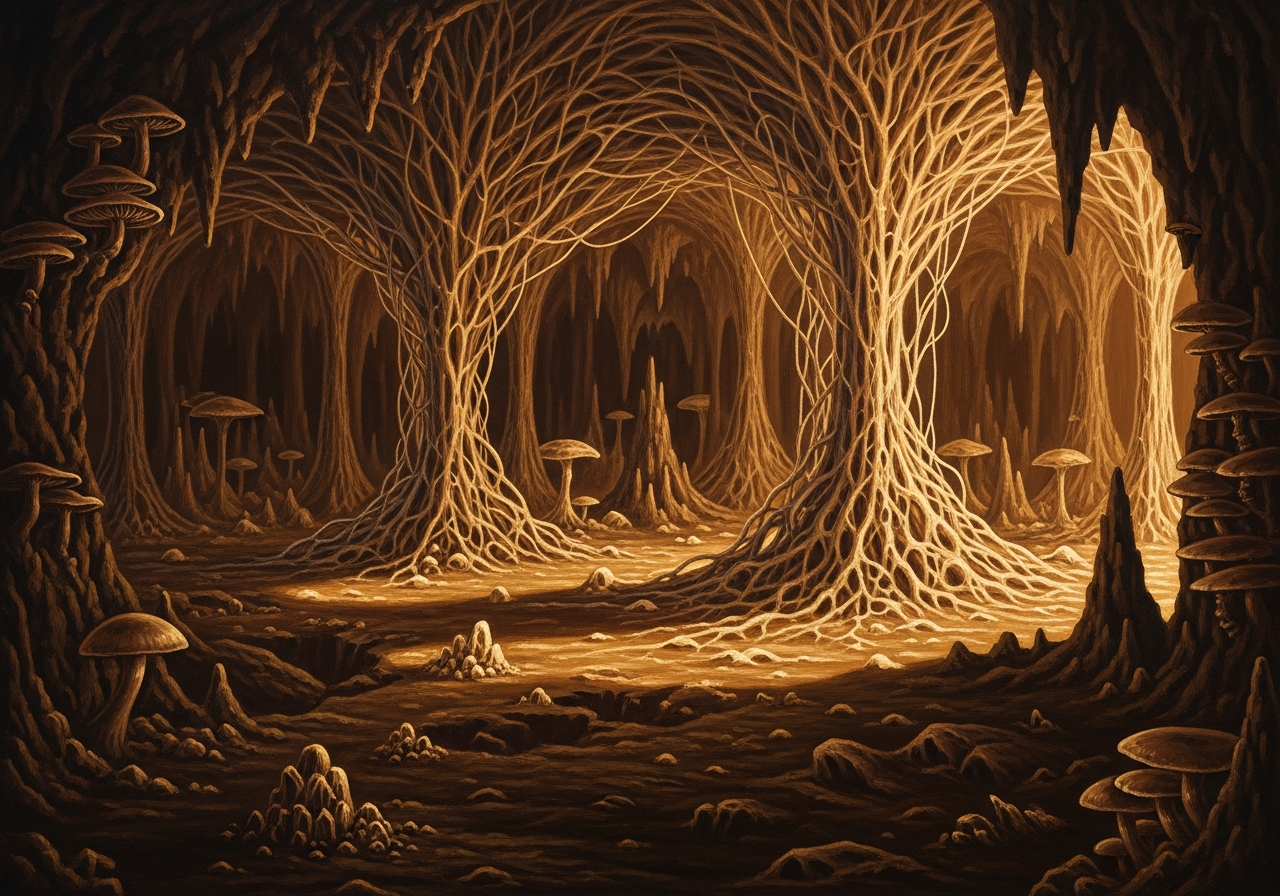
The secret is a gigantic, underground network of fungal threads, known as mycorrhiza. These fine threads intertwine around the roots of individual trees, connecting them to one another – often over vast distances and even across species boundaries. This "Wood Wide Web" is the infrastructure for a constant exchange. Trees not only send nutrients like carbon and water to weaker neighbors, but also complex information. If a tree is attacked by pests, it sends biochemical warning signals through the network, allowing other trees to activate their defense mechanisms even before they are themselves attacked. It is a silent, invisible flow of information, a conversation that takes place at the molecular level.
A Community, Not Competition
This discovery is more than just a fascinating biological footnote. It challenges our deeply rooted ideas of individuality and competition. In our culture, we often celebrate the individual hero, the entrepreneur who achieves success alone. The forest shows us a different model: a quiet, unobtrusive solidarity.
Here, it's not primarily about the individual's struggle for light and water. It's about a system of mutual support. Older, established "mother trees" nourish their offspring and even the saplings of other species through the root network until they themselves receive enough light. A forest is less a battlefield of the strongest than a cooperative community that, as a whole, is more resilient than the sum of its parts.
This communication, however, is unsettlingly slow. A message from one tree to the next can take hours, days, or weeks. The response to a threat is not a swift reflex, but a slow, collective adaptation. Our communication is designed for immediate response; an unanswered message creates unease after just minutes. We think in quarters and project sprints. Trees think in seasons, decades, centuries. Their conversation is one of patience. They are not in a hurry, for they are not on their way to a destination. They are already there.
An Invitation to Listen with Other Senses
We cannot eavesdrop on this conversation. We cannot decipher the chemical signals. But perhaps it's not about understanding the content at all. Perhaps the invitation lies in acknowledging the existence of this conversation – and thereby changing our own perception.
This is exactly what you can try on your next walk. It's not a test, but an opportunity to encounter the forest in a new way.
Find a tree that speaks to you. It doesn't have to be particularly old or large. Approach it closely and, for a moment, place a hand on its bark. Close your eyes, if you wish. You won't hear words, but try to direct your attention to something else. Feel the rough or smooth texture of the bark beneath your palm. Feel the silence, which is not an emptiness, but filled with an infinitely slow life. Feel the firm ground beneath your feet and imagine the delicate, invisible network that connects this one tree to countless others from this very spot.
In this moment, it's not about learning a foreign language. It's about becoming still for an instant and sensing that perhaps you are never truly alone – but always part of a larger, quieter conversation.
Further Reading
- Simard, Suzanne. Finding the Mother Tree: Discovering the Wisdom of the Forest. Ullstein, 2021.
- Wohlleben, Peter. The Hidden Life of Trees: What They Feel, How They Communicate – Discoveries from a Secret World. Ludwig, 2015.
- Haskell, David George. The Songs of Trees: Stories from Nature's Great Connectors. Viking, 2017.
You Might Also Be Interested In
The Invisible Architecture of Calm
The forest is a place of comforting silence. If you appreciate this experience, discover more public spaces here where shared tranquility provides focus and renewed strength.
What if Happiness Isn't a Goal at All?
Trees are not on their way to a destination; they simply are. Does this thought inspire you? Then learn here why the constant pursuit of happiness can prevent us from finding it.
The World in a Hand Movement
The communication of trees is a hidden language of nature. Learn about another invisible language here: that of our hands and what everyday gestures reveal about culture and knowledge.