
Some places embrace us the moment we step inside them. A café where one effortlessly sinks in, opens a book, or simply gazes out the window. Others, however, seem to gently turn us away. One might want to leave after the first sip of coffee, without quite knowing why. The music isn't too loud, the chair isn't uncomfortable, the scent isn't disturbing. And yet, there's a feeling, a subtle dissonance, that quietly urges us to depart.
Perhaps you know this feeling. This almost physical intuition for whether a place "feels right." It is the intuition that safely guides us down a particular alley in a foreign city, that allows us to find peace in a specific spot in the library, or that bestows upon us an unexpected sense of home on a park bench. We often vaguely call it "mood" or "atmosphere," yet behind it lies one of the most fundamental ways we experience the world.
More Than Just a Matter of Taste
The atmosphere of a place is more than the sum of its parts. It arises in the in-between: in the light filtering through a window, in the soft murmur of conversations, in the scent of old wood. These impressions interweave into a whole that affects us directly – often before we consciously analyze it. The atmosphere of a space speaks a language we instinctively understand, because it appeals not just to our mind, but to our entire physical being.
The Space Between Things
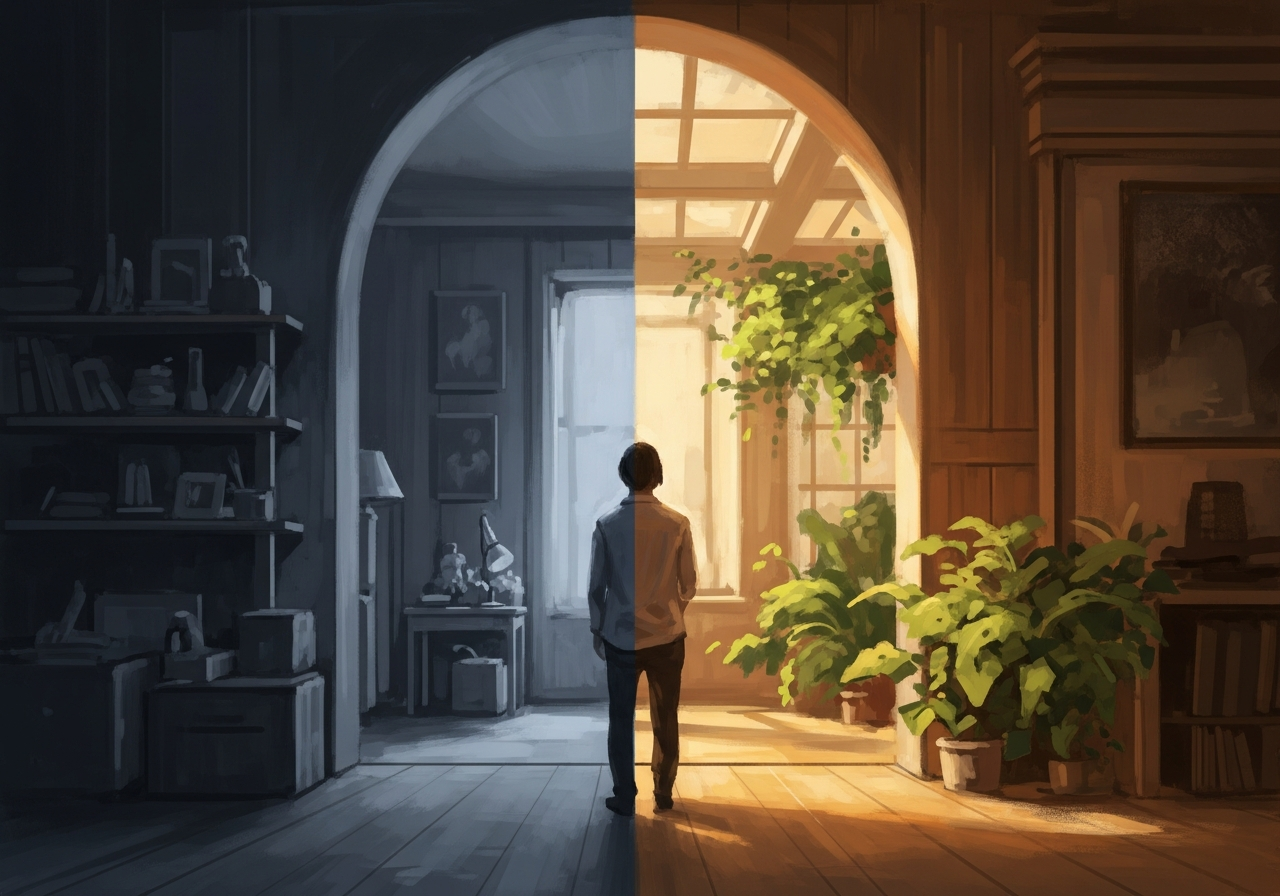
The philosopher Gernot Böhme has given a name to this phenomenon. For him, atmosphere is neither an objective quality of the space nor a purely subjective feeling within us. It arises precisely in the encounter – in the space between us and the world. It is a "felt presence" that surrounds us like the weather. We can scarcely escape it; we step into it and immediately become a part of it.
This explains why the transition from a bustling shopping street to the stillness of an old church can transform us so abruptly. It is not merely the acoustics that change, but our entire state of being: Our breath becomes calmer, our movements slower, our thoughts more reflective. The environment doesn't just shape our mood – it actively alters who we are in that moment. Every place invites a different version of ourselves to emerge.
A Quiet Conversation
Becoming aware of this invisible architecture has nothing to do with optimizing our surroundings. Rather, it is an invitation to feel more deeply. Instead of asking what a place evokes within us, we can shift perspective: What is this space doing to me right now? Who is it making of me? What feelings, memories, or thoughts are not just awakened, but actively shaped?
Sometimes, in this process, we discover a deep connection. The feeling of home, perhaps, is nothing other than this familiar resonance with places that allow us to be truly ourselves. And sometimes we sense an unfamiliarity, which also reveals something important to us: about our longings, our boundaries, and what we seek in life.
The relationship between us and the places where we live is not a one-way street. We shape spaces, but spaces also shape us. A small thought to take with you: The next time you enter a space – be it your office, a waiting room, or a friend's home – pause for a moment. Ask yourself not only what changes within you, but also what you yourself bring into that space. Simply by your presence, your demeanor, your stillness. That is the beginning of a true dialogue.
Further Reading
- Gernot Böhme: Atmosphäre: Essays on the New Aesthetics. Suhrkamp Verlag, 2013. A philosophical yet accessible foundation on the topic.
- Juhani Pallasmaa: The Eyes of the Skin: Architecture and the Senses. John Wiley & Sons, 2012. An influential book on how architecture appeals to all our senses, not just sight.
- Alain de Botton: The Architecture of Happiness. Penguin Books, 2007. Explores in an entertaining and profound way the connection between our built environments and our well-being.