
Perhaps you know this movement: The way someone peels an apple. Not in small, choppy pieces, but in a single, long spiral. The thumb of one hand serves as an anchor, while the other hand places the small knife at an almost imperceptible angle against the skin, slowly turning the fruit. It is a movement that is both economical and elegant, a small choreography of the everyday.
If one looks closely, one often discerns an echo within it. The movement resembles the one with which a mother or grandfather once prepared apples for a cake. As a child, one observed it countless times, without ever receiving formal instruction. One day, one takes the knife into one's own hand and realizes that the movement is already there. It has inscribed itself into one's own body through pure observation, a silent legacy passed down from one generation to the next.
The Memory of Hands
There is a knowledge that cannot be captured in books or instructions. It is the knowledge of the hands. The baker who, with closed eyes, feels whether a dough has the right consistency. The violin maker who reads the wood beneath their fingers. Or the weaver whose hands seem to know the pattern before the mind has fully grasped it.
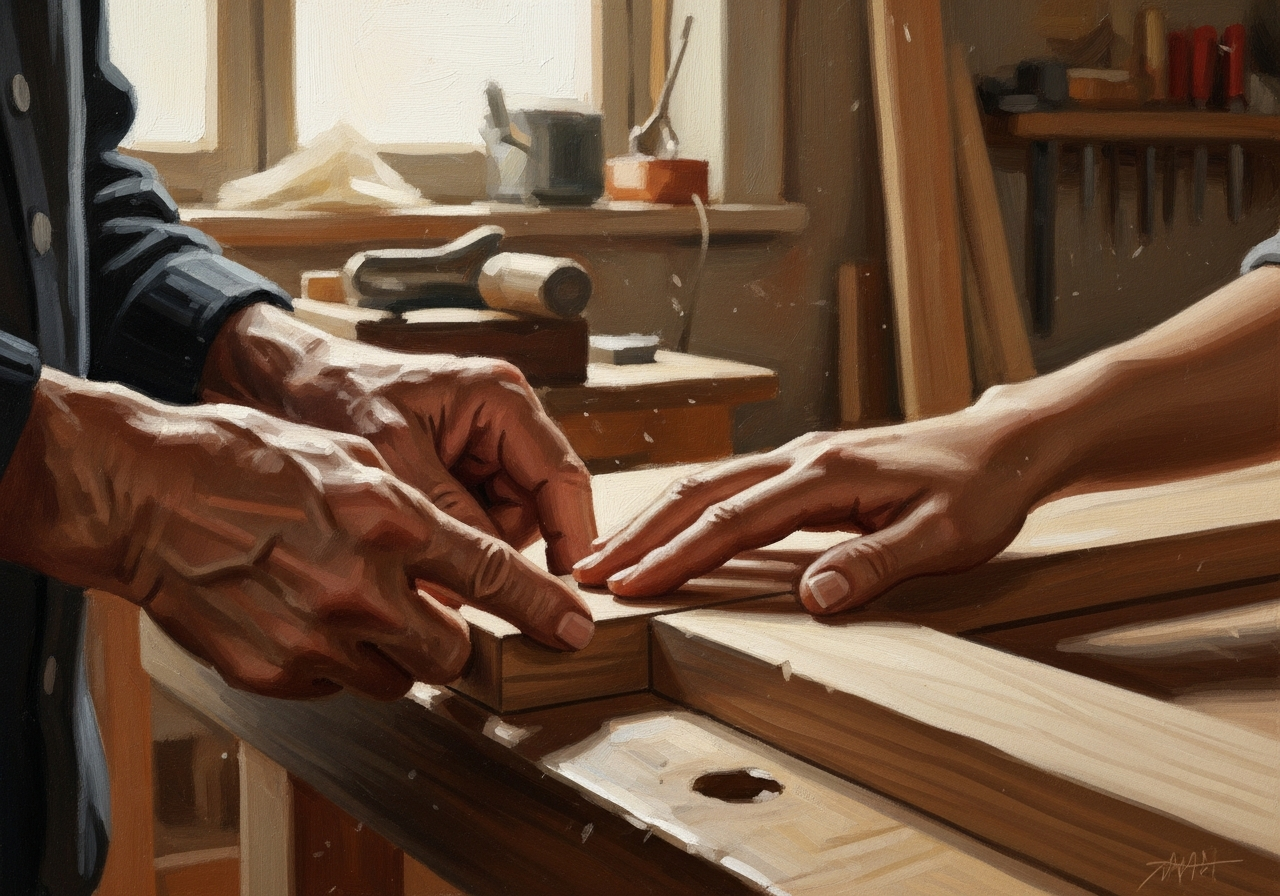
This form of knowledge is also called implicit or embodied knowledge. It arises through repetition, through imitation, through the precise observation of a master. It is a learning that has more to do with muscles and nerve pathways than with conscious intellect. The philosopher Michael Polanyi summarized this idea in the famous sentence: “We can know more than we can tell.” Our hands often know how something is done, long before we could put it into words. They carry within them the memory of thousands of small, corrected errors and successful attempts.
A Language Without Words
Such learned gestures are a kind of language. The way an Italian grandmother, with a precise hand movement, indicates that the food is ‘perfetto’. The almost imperceptible nod of a watchmaker, signaling approval without taking their gaze from the delicate work. Or the way a shirt is folded – not just any way, but according to a method passed down from a father or learned during military service. They speak of origin and belonging, of meticulousness and experience. A movement that has become second nature is often more than just a technique. It is a piece of lived culture, a miniature of craftsmanship in everyday life.
The Grammar of Gestures
While many of our hand movements are standardized by the smooth surfaces of screens, nonverbal communication remains astonishingly diverse and culturally shaped. A fascinating example are so-called “emblematic gestures” – movements with a direct, fixed meaning. The gesture for “Come here,” for instance, is performed differently worldwide: in North America with an upward-turned palm and curling fingers, yet in many parts of Asia with a downward-turned palm and a fluttering movement of the fingers. The same intention, an entirely different choreography.
Next time, pay attention to how differently people in a café signal to get attention for ordering. Is it a brief eye contact, a raise of the hand, a subtle wag of the index finger? Each of these gestures is an unconscious decision, shaped by cultural norms and personal habits. How many different gestures do you estimate you could discover in a single café? Whose movement continues within it? What small, almost forgotten story does your hand tell, without uttering a single word?
Further Reading
- Richard Sennett, “The Craftsman”: A foundational work on the significance of craftsmanship for thought and culture. Sennett reveals how the hands educate the mind.
- Michael Polanyi, “The Tacit Dimension”: In this classic, the philosopher and scientist develops his theory of implicit knowledge – the idea that we know more than we can articulate.
- Tim Ingold, “Making: Anthropology, Archaeology, Art and Architecture”: A fascinating look at how humans shape their world and themselves through making and creating.
You Might Also Be Interested In
The Art of Not Knowing
This article has shown how much knowledge resides in our unconscious gestures. But what happens when we consciously question these routines and observe the world again with the curiosity of a beginner?